

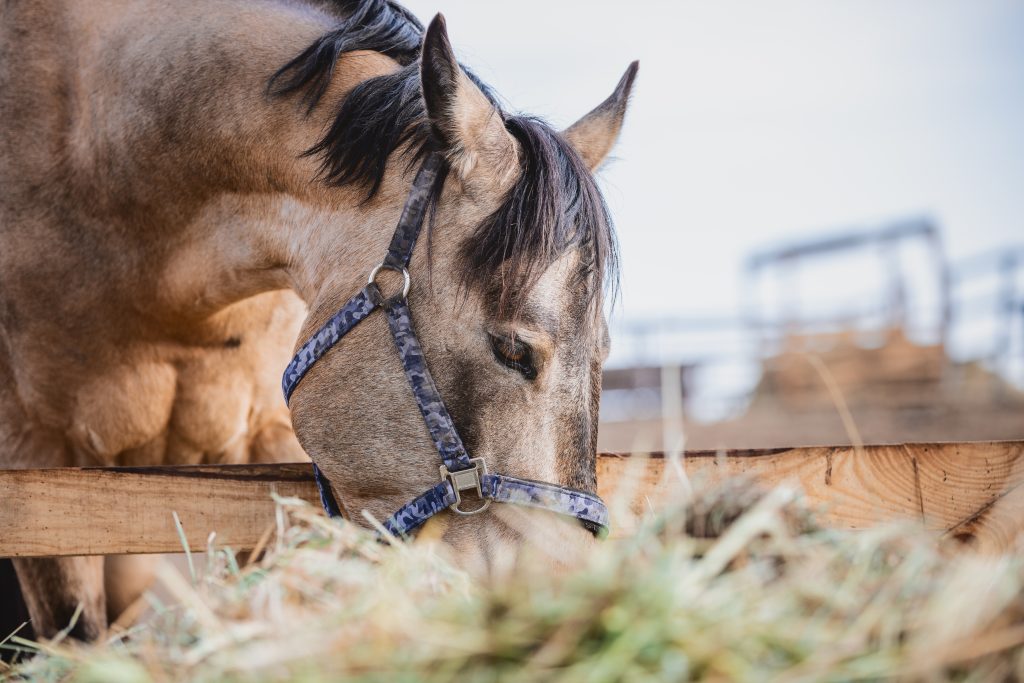

If your hay supply is running low, supplement it with products that provide fibre rather than simply feeding more concentrates. The best option depends on your horse: grass products, lucerne or soaked pellets can all have their place. Maintain a minimum dry matter intake of 1.5% of your horse’s body weight per day and introduce any dietary change gradually over ten to fourteen days.
You walk past your hay stack at the end of August, count the bales and wonder: will this last me until spring? After this summer, more horse owners are asking themselves that question than usual. Drought has significantly reduced yields in many areas, with large differences between individual fields.
The good news is that there are things you can do. The less good news is that the most obvious solution — simply feeding a little more concentrate — is not necessarily the best one. Below, we explain what does work and what you should consider with each option.
Start with a number, not a feeling. The minimum recommended intake, reflected both in international feeding standards and practical advice from equine veterinarians, is at least 1.5% of body weight in dry matter per day.
For a 600 kg horse, that means at least 9 kg of dry matter. Hay consists of around 80 to 90% dry matter, so in practice this works out at approximately 10.5 kg of hay per day. And that is the minimum, not the target.
Weigh what actually goes into your haynet at least once. Almost everyone who does this for the first time is slightly surprised. We often misjudge how much our horses are really being fed, and in many cases the amount of forage is also too low. Without weighing it, everything that follows remains guesswork.
This is no longer just a question being discussed on yards. Researchers are also looking at the issue, and the common theme is that we need to start thinking beyond hay alone.
Earlier this year, two British researchers addressed the subject: Dr Simon Daniels of the Royal Agricultural University and Prof Meriel Moore-Colyer of Hartpury University. They expect unpredictable weather conditions to remain an issue and believe the equine sector therefore needs to consider alternative forms of forage.
Haylage, for example, can be harvested earlier in the season, when there is still more moisture in the soil and rainfall tends to be higher. Lucerne is another option, as it can be grown and conserved reliably in our climate. Daniels points to German stud farms that have started producing more lucerne hay for this reason.
What they both emphasise is just as important. Nobody needs to stop feeding hay or completely reinvent their horse’s diet. It is about making small adjustments: feeding some hay and supplementing it with another source of forage. Daniels also notes that many owners underestimate how much energy forage can provide, resulting in concentrates being added unnecessarily. A forage analysis can be more useful than you might think.
There is no single correct answer. There are four main options, and the best choice depends on the individual horse.
Grass products. Dried grass in chopped or pelleted form is compositionally the closest option to the hay you are already feeding. This makes it the safest choice if your horse is doing well on its current diet and you simply need to make up a shortfall in quantity. Another practical advantage is consistency in quality, which is particularly valuable in a year when hay quality varies significantly.
Lucerne. Lucerne contains more protein and calcium than grass and is therefore particularly useful if your forage analysis shows deficiencies or if your horse could benefit from additional protein for muscle development and recovery. Lucerne is also drought-resistant, which means it can remain readily available in a year when forage supplies are tight. It is not a universal solution, however, and there are some points to consider, which we discuss later in this article.
Soaked cubes and pellets. Grass or lucerne pellets that are soaked before feeding can be an excellent option for older horses, horses with dental problems and horses that are sensitive to dust. They also increase water intake, which can be particularly useful during winter.
Straw, but in moderation. Straw provides fibre and chewing time at relatively low cost and can make up 10 to 30% of the forage ration for horses that would otherwise consume too much energy. However, it provides very few nutrients, so it is not suitable as the main replacement for hay. Straw can also increase the risk of impaction colic. This risk arises when the digestive system struggles to ferment the product. Introduce it gradually as well: suddenly feeding a large amount of straw is not without risk.
One principle applies to all four options: if there is a gap in the forage ration, fill it with forage rather than concentrates. Concentrates may provide energy, but they do not provide the same chewing time or gut fill.
Lucerne has become something of a controversial topic in recent years. Some people present it as the solution to everything, while others advise against feeding it altogether. Both positions are too absolute. Here is what we actually know.
What lucerne does well. It is rich in protein and provides the essential amino acids your horse needs for muscle development and recovery. It is naturally low in sugar and contains no starch. It provides structure and therefore chewing time, and it buffers stomach acid more effectively than grass hay.
The calcium question. Lucerne is known for being naturally rich in calcium — around 1.3% — which directly affects the calcium-to-phosphorus ratio (Ca:P) of the total diet. Ideally, this ratio should be between 1.4:1 and 2:1. A ratio of 1.2:1 to 3.5:1 is generally considered acceptable. Ratios of up to 1:6, with considerably higher calcium intake, may also be acceptable, but only when sufficient vitamin D is present in the diet.
For foals, young horses and pregnant or lactating mares, the situation is different: the ratio should remain within approximately 1:1 to 2:1. Growth and lactation mean that greater attention must be paid to the calcium-to-phosphorus balance.
As a rule of thumb, lucerne works well for horses that can benefit from additional protein. This includes sport horses recovering from exercise, older horses losing muscle mass and horses whose forage has tested low in protein.
Not sure? Use Hartog’s free feeding advice or ask an equine nutritionist to assess your forage analysis. We will be happy to help you find the right solution.
One more point that is often confused: a lucerne mix is not the same as feeding pure lucerne. A mix combines lucerne with other fibre sources, which means the protein and calcium content per kilogram is lower than that of lucerne hay. Always check the nutritional analysis of the product you are actually putting in the feed bucket.
Start by doing the maths. Weigh your horse’s daily hay ration, count your bales and divide the total number of kilograms by your daily requirement. That will tell you how long your supply will last. From that point onwards, you are dealing with a measurable shortfall in kilograms rather than a vague feeling that you might run out.
Next, have your hay analysed. In a dry year, its nutritional composition may differ from what you are used to, making an analysis particularly valuable. The results will also help determine which supplement makes sense. If your hay is low in protein, lucerne may be a good option. If protein levels are already adequate, a grass product may be the better choice.
Then choose your supplement. The following products in our range are suitable for supplementing your horse’s forage ration:
Finally, do not forget vitamins and minerals. Forage and forage-based products generally do not contain added vitamins and minerals. If your horse receives little or no concentrate feed, supplement the diet with a balancer such as Hartog Essential.
How much hay does my horse need at a minimum each day?
Allow for at least 1.5% of body weight in dry matter. For a 600 kg horse, this means 9 kg of dry matter, or approximately 10.5 kg of hay at a dry matter content of 85%. More is acceptable; feeding less is not recommended.
What is the best way to supplement hay?
Use products that provide fibre. Dried grass is compositionally the closest alternative to hay and is the safest choice. Lucerne can be useful if your forage is low in protein. Soaked cubes or pellets are suitable for older horses or horses that are sensitive to dust. Straw can replace a small proportion of the ration but is not a full substitute for hay.
Is lucerne bad for my horse?
No, but it is not necessarily the best choice for every horse either. Lucerne is rich in protein and calcium, which is beneficial for horses that need those nutrients but may be less suitable for foals and broodmares. For foals and broodmares, another form may be preferable, such as lucerne pellets.
Why is lucerne still available in a dry year?
Lucerne has a deep root system, allowing it to access moisture in soil layers that grass cannot reach. This makes the crop less sensitive to drought than grassland.
How quickly can I switch to another forage product?
Introduce it gradually over ten to fourteen days. Start with a small amount of the new product and increase it step by step while reducing the previous feed accordingly. This gives the gut flora time to adapt.
Receive the latest offers, exclusive content and news from Hartog Family Farms.