

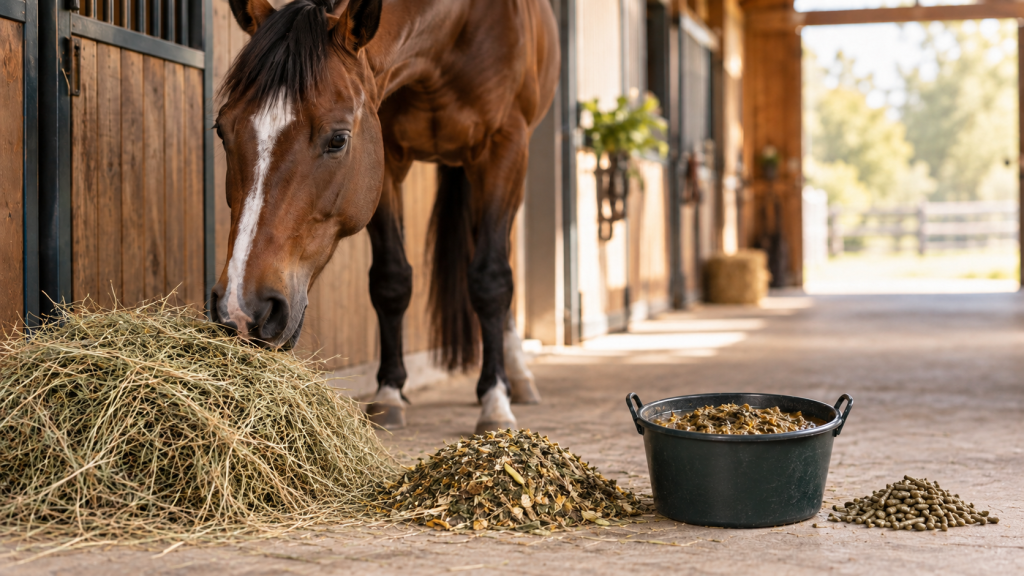
Say forage and most people picture hay. But forage is far broader than that – and the form you choose has consequences for chewing time, saliva and feed intake.
Forage for horses includes hay and haylage, forage mixes (chopped forage), soaked forage and forage pellets. Long, structural forage should make up the largest part of the ration, because it stimulates saliva production and slows feed intake. Soaked forage is mainly a solution for horses that can no longer chew structure properly.
Hay and haylage. The basis in most yards. Long, structural fibre.
Forage mix (chopped forage). Chopped forage, often with added ingredients. Shorter fibres, but still structure – and easy to mix through concentrate.
Soaked forage. Forage mashes and soaked pellets. Soft, quick to eat, very little chewing required.
Forage pellets. Compressed forage in pellet form, such as lucerne pellets. Fibre-rich and energy-dense.
Feed your horse mainly on structural forage. That brings two concrete advantages.
In short: structure does something that nutritional value alone does not.
In older horses with dental problems, structural forage sometimes stops working. You will recognise it by quids: the horse can no longer chew its feed properly and drops small balls of half-chewed forage. Slow eating and weight loss over winter are signals too.
At that point, moving to soaked forage may be necessary.
Maartje’s tip: take the intermediate step first. Choose a fine, soft chopped forage mix before you move to soaked forage. Hartog Senior was developed specifically for this. By avoiding soaked forage for as long as is responsible and staying with structural forage – even if that means a very soft mix – you preserve chewing time and saliva production for longer.
| Situation | What fits |
|---|---|
| Healthy teeth, normal requirement | Hay or haylage as the basis |
| Extra structure and eating time needed | Forage mix alongside the ration |
| Higher energy requirement, keep it fibre-rich | Forage pellets (lucerne pellets) |
| First signs of chewing problems | Fine, soft chopped forage mix |
| Chewing no longer works at all | Soaked forage / forage mash |
Is a forage mix the same as concentrate? No. A forage mix consists of chopped forage and counts towards your forage ration. Concentrate is a supplement with a different function.
Can forage pellets replace hay? Partly. Forage pellets are fibre-rich but provide little chewing time. Always keep a proportion of structural forage in the ration.
How do I know my horse is quidding? By the half-chewed balls of forage left in the stable, by the hay rack or in the field. If you find them, have the teeth checked by an equine dentist.
Should I always avoid soaked forage? No. It is a good solution when chewing genuinely no longer works. The point is to postpone it for as long as is responsible, because structure has benefits of its own.
Receive the latest offers, exclusive content and news from Hartog Family Farms.