

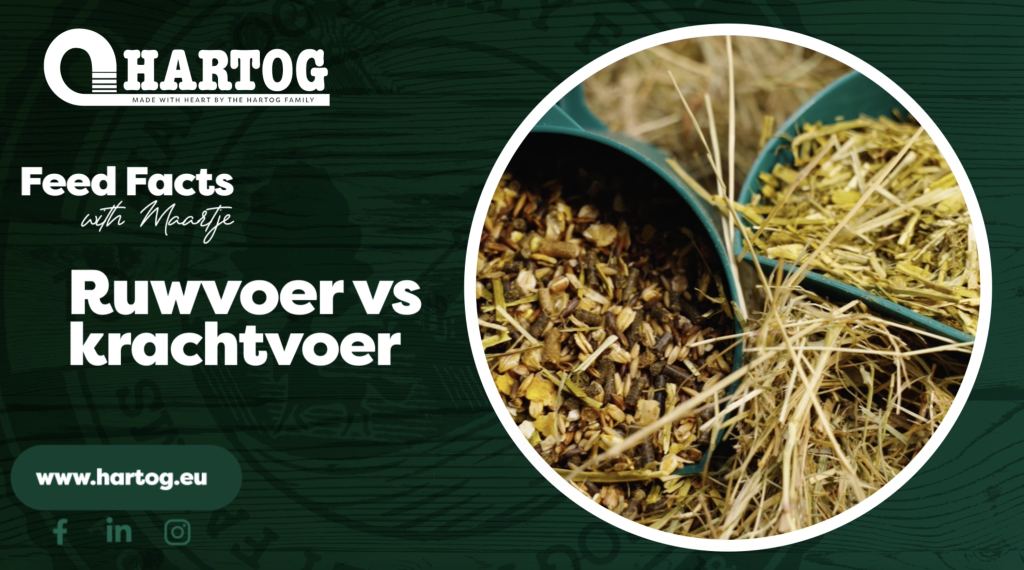
Many people look for the energy in the concentrate, while the foundation of the ration lies somewhere else. In this episode Maartje compares forage and concentrate: where each one is digested, what kind of energy it delivers, and how the label tells you which of the two you are holding.
Forage and concentrate differ mainly in where they are digested. Traditional concentrate is made from whole grains and is therefore a source of starch, broken down by enzymes at the front of the digestive system for quickly available energy. Forage is fermented by bacteria at the back and delivers slow-release energy.
The difference is not about “a lot” or “a little” energy. It is about where the energy is released and how quickly.
Those two routes run through different parts of the digestive system, and that explains everything that follows.
Starch is digested in the first part of the digestive system, in the small intestine, by enzymes. The building blocks released there are absorbed on the spot. The result is a relatively fast rise in available energy.
That is exactly what you want for short, intensive work. It is also exactly what you do not want in a horse that becomes sharp or unsettled by it, or in a horse that does not handle that amount of starch well. How much starch a horse can cope with per meal is limited; episode 3 covers that.
Fibre flows on almost unchanged to the second part of the digestive system: the caecum and large intestine. There it is fermented by bacteria. The volatile fatty acids produced in the process are absorbed by the horse as energy.
That process is gradual. Forage is therefore a genuine source of slow-release energy, without the peak that starch produces.
Feeding on fibre can be a smart choice for:
Worth being honest about: less concentrate does not automatically mean less energy. Nutritious forage, such as lucerne pellets, can cover a large part of the energy requirement without raising the starch load.
Alongside traditional concentrate there are now a great many types of horse feed on the market. Names such as “muesli”, “balancer”, “structure feed” or “mash” say very little in themselves. Working out which feed suits your horse can be a real challenge.
The solution is simple: look carefully at the label. Check the contents of:
That tells you whether a product is a source of quickly available or of slow-release energy. The name on the bag does not; the analysis does.
Is concentrate bad for my horse? No. It comes down to the amount per meal, the spread across the day and whether your horse actually uses the energy. A horse with a higher requirement can use concentrate perfectly well.
Can I replace concentrate entirely with forage? Often to a large extent, provided the forage is nutritious enough and the vitamins and minerals are covered another way. Have the ration calculated before you take big steps.
How do I tell whether a product is fibre-rich? From the crude fibre content on the label. Products at around 20% or more are generally a good source of fibre.
How quickly can I switch from concentrate to fibre-rich feed? Allow at least two weeks. The bacteria in the large intestine need time to adapt; an abrupt switch brings a risk of colic and diarrhoea.
Receive the latest offers, exclusive content and news from Hartog Family Farms.