

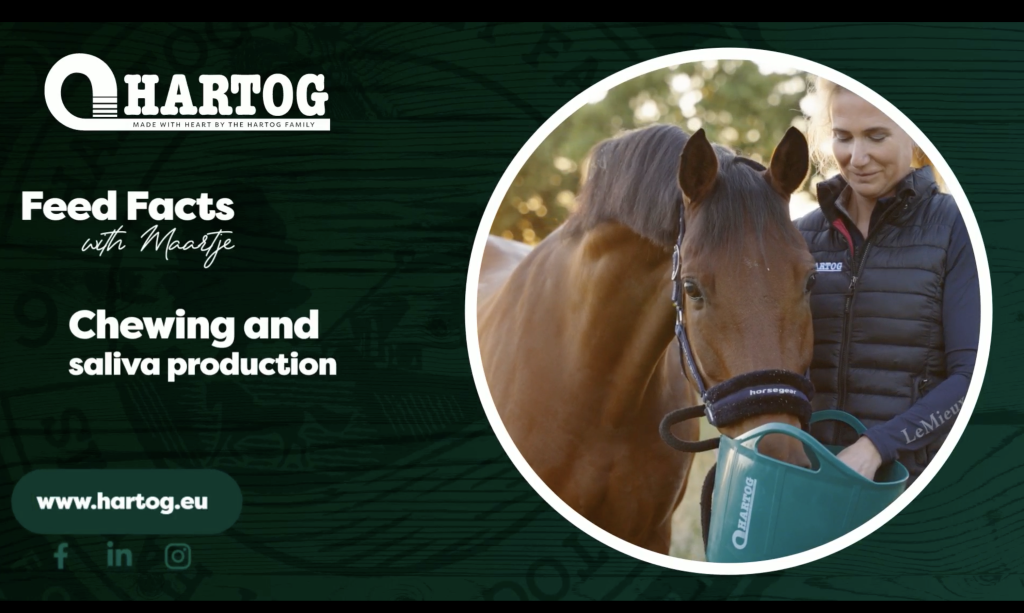
You have probably heard the rule: never leave a horse without forage for more than four hours at a stretch. In this episode Maartje explains where that rule comes from.
A horse produces stomach acid continuously, even when it is not eating. Forage creates chewing, chewing produces saliva, and saliva together with the forage itself helps buffer that acid. If a horse stands too long without forage, acid is left in an empty stomach. That raises the risk of gastric ulcers.
Continuous intake of fibre-rich feed. In a natural setting a horse spends up to eighteen hours a day eating. Our horses live a very different lifestyle in many situations – but their digestive systems have not changed with it.
So even a stabled horse needs to be able to eat enough forage, without long gaps in between.
Stomach acid is produced continuously, whether or not the horse is eating. In a grazing horse that acid is constantly diluted and buffered by saliva and by fibre-rich stomach contents. In an empty stomach, neither happens.
One of the problems that can develop as a result is a gastric ulcer. The international consensus statement from the European College of Equine Internal Medicine explicitly names restricted forage availability and long periods without feed as risk factors.
During exercise, abdominal pressure pushes the stomach contents upwards. Stomach acid can then splash onto the upper, less protected part of the stomach lining.
Forage helps in two ways:
So feed a small amount of forage before you train. While grooming and tacking up, for instance – which also happens to be the most practical moment.
A well-planned forage ration is essential to keeping the digestive system healthy. Most of these changes cost nothing at all – they are about timing rather than quantity.
How long can a horse go without forage? As a rule of thumb, no longer than four hours at a stretch. Shorter gaps are better, including overnight.
Does a slow feeder really help? A net or slow feeder with small openings extends eating time for the same amount of forage. That is precisely the point: not feeding more, but keeping the horse occupied for longer.
How much forage should you feed before riding? A small amount is already worthwhile – think of a handful up to half a kilo of forage mix while you get ready. The aim is a stomach that is not empty, not a full meal.
Could my horse have gastric ulcers without me noticing? Yes. Gastric ulcers often produce vague signs. Only gastroscopy gives certainty. If in doubt, speak to your vet.
Receive the latest offers, exclusive content and news from Hartog Family Farms.