

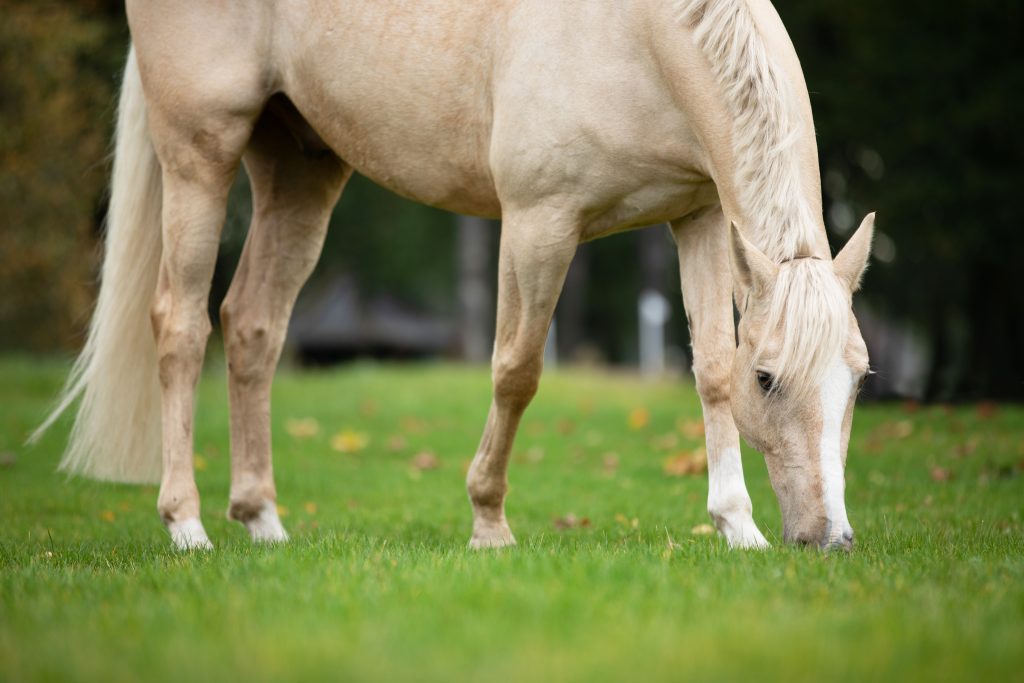


With a proper understanding of the fructan index, your horse can safely graze throughout the summer. The fructan content in grass fluctuates significantly under the influence of temperature, sunlight and growth rate. Without knowledge of these changes, a horse may unknowingly ingest too much fructan, with all the potential health risks that come with it. That is precisely why understanding and monitoring the fructan index is not a luxury, but an essential part of responsible pasture management.
Fructan is a type of sugar found in grass. It serves as an energy storage form for the plant. When grass produces more energy than it can use for growth, it stores this excess energy as fructan.
Horses are unable to properly digest fructan in the small intestine, meaning that large amounts can pass into the hindgut, where they may cause problems.
Horses have evolved to consume large amounts of low-energy, fibre-rich forage. Today, grass on well-maintained pastures often contains more sugars than their digestive system can handle. A fructan content that is too high can lead to:
That is why understanding the fructan index is essential for responsible pasture management.
The fructan index is an indication of the amount of fructan in grass at a given moment. It is not an exact measurement, but a guideline based on weather conditions such as temperature, sunlight and growth circumstances.
The index takes into account factors such as:
The colder the night and the sunnier the day, the higher the likelihood of elevated fructan levels in the grass.
Factors influencing fructan content:
When grass experiences stress, for example due to cold temperatures or intensive grazing, the fructan content increases. This is often the case in short-grazed horse pastures.
Grass is not only a source of fibre, but also an important factor in managing your horse’s fructan intake. The composition of the pasture, the type of grass, and the time of year all have a direct influence on the fructan content in grass. By managing these factors carefully, you can significantly reduce the risk of health problems.
Not all grasses contain the same amount of fructan. For example, perennial ryegrass contains more fructan than herb-rich mixtures. The composition of your horse pasture therefore makes a significant difference.
The fructan content in grass is highest in spring and autumn. Sunny days followed by cold nights are particularly high-risk. During these periods, it is advisable to limit or adjust grazing time, especially for horses that are prone to laminitis or colic.
The fructan index is particularly valuable when you actively apply it in your daily pasture management. By carefully assessing current conditions and the risk of elevated fructan levels in grass, you can make practical decisions that suit your horse.
When the fructan index is high, you can:
Many people look for a fructan meter to measure the fructan content in grass themselves. Unfortunately, there is currently no reliable handheld device available that allows you to determine the exact fructan content in your pasture on a daily basis.
However, there is a practical solution: Hoefnatuurlijk has developed an online fructan index. Here, you can check today’s fructan index directly. This fructan index provides an indication of the expected fructan content in grass for each location. It is not a direct measurement, but a prediction based on weather data such as temperature (especially night-time temperatures) and the number of sunshine hours. In this way, as a horse owner, you receive a daily estimate of the risk of elevated fructan levels in the grass.
Check the up-to-date fructaanindex hier op de site van hoefnatuurlijk.
A common mistake is thinking that young grass is dangerous. Young grass grows quickly and therefore stores little fructan. As long as the grass is actively growing, the fructan content remains relatively low. However, when night-time temperatures drop below 5°C, grass growth slows or stops, and excess sugars are stored as fructan. The colder the night, the greater the storage. Grazing after cold nights is therefore the most risky. In contrast, grazing after warm nights is the safest, as fructan levels are then at their lowest.
Another common mistake is allowing the horse pasture to be grazed too short. When grass is grazed too short, it becomes stressed and produces more fructan in order to recover. In addition, fructan is stored in the lower part of the stem, just above the root. This means that when grass is very short, horses are actually eating the most fructan-rich parts.
The fructan index is a valuable tool for every horse owner. By monitoring the fructan index and taking the fructan content in grass into account, you can help prevent health problems. A well-managed pasture, combined with knowledge and careful observation, contributes to a fit and healthy horse.
Always continue to assess your horse critically. Every horse responds differently to grass, grazing time, and changes in diet. Pay attention to signs such as hoof sensitivity, changes in behaviour, or fluctuations in weight, and adjust your management accordingly.
Are you unsure about your horse’s diet or would you like personalised advice for your specific situation? We are happy to help with free, personalised feeding advice.
Receive the latest offers, exclusive content and news from Hartog Family Farms.