



Colic occurs in horses worldwide. However, there are certain risk factors. For example, it has been observed that colic is more common in Arabian horses than in racehorses. Horses with inconsistent water intake are also more susceptible than those with unlimited access (Reeves et al., 1996; Curtis et al., 2019). Increased risk is also observed in horses fed whole corn, horses with severe dental problems, those with stereotypic behaviors or those having received an anthelmintic within 6 months (Salem et al., 2017). However, horses that are dewormed regularly are less prone to colic (Reeves et al., 1996; Curtis et al., 2019). Age, diet, and the person caring for the horse also play a role (Reeves et al., 1996; Curtis et al., 2019).
Although colic is mainly associated with digestive causes, abdominal pain can also be caused by various other pathologies. Therefore, it is important not to overlook abdominal pain related to the renal, urinary, reproductive systems, and others. Digestive colic can be classified according to its cause, the target organ and its duration. Among these causes we find:
The target organ can be the:
Finally, the cecum can be tympanic or impacted as well. Colic is defined by its duration and can therefore be acute (less than 36 hours of pain), chronic (more than 36 hours), or recurrent (if colic episodes occur regularly) (Ragab, 2023).
Horse owners are often aware of the signs that horses may exhibit during colic. Abdominal pain is manifested by visible behavioral changes: the horse turns in small circles, lies down and gets up constantly, kicks its belly, looks at its flanks, rolls or gets stuck on its back (Rhodes and Madrigal, 2021). Male may have its penis out without urinating or urinating small amounts. Horses may also play with water without really drinking (Dukti , 2012; van Loon and Van Dierendonck , 2015; Constable et al., 2017; Mair and Sherlock, 2023; Talbot et al., 2023). A camped position may be observed. The same is true for a swollen abdomen (Constable et al., 2017; Mair and Sherlock, 2023). The first thing to do when you notice these symptoms is to call your veterinarian. This is a life-threatening emergency.
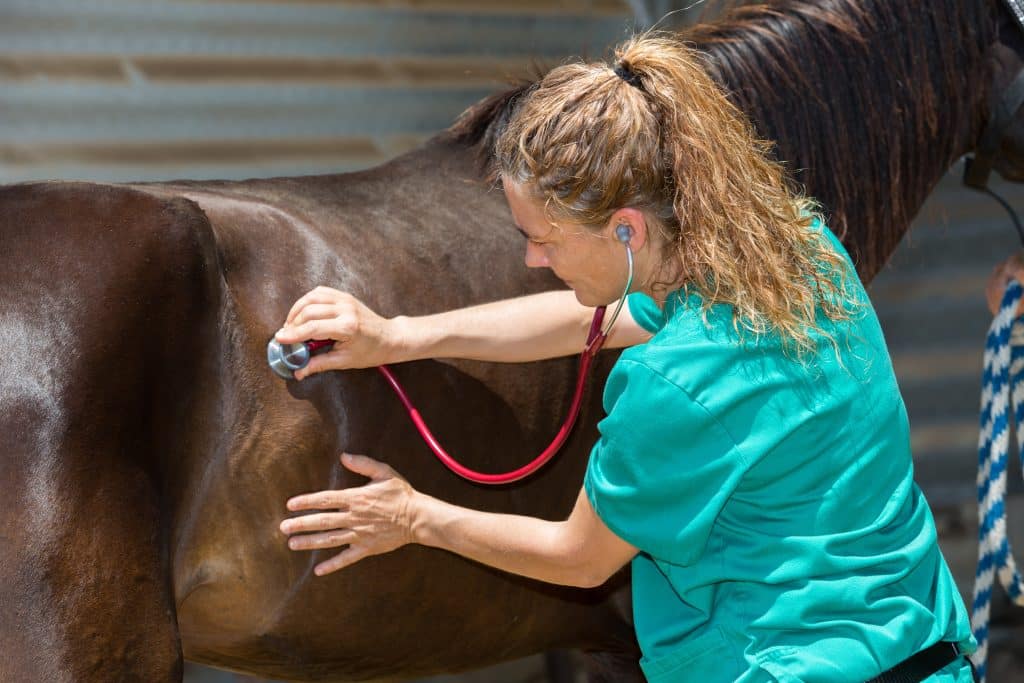
The veterinarian will conduct a complete emergency examination. Which includes:
Medical treatment at home is sufficient in most cases. However, some more advanced cases will require hospitalization. Medical treatment includes several approaches: fasting, movement, pain reduction, restoration of body fluids, gastrointestinal lubrication and finally treatment of underlying diseases. Fasting is essential while the colic resolves, followed by gradual refeeding. The horse will also be walked or sometimes trotted in order to stimulate intestinal transit. Pain reduction will be done with painkillers that are generally not very powerful so as not to mask the symptoms or antispasmodics. Fluid restoration consists of placing an intravenous catheter and administering fluids. Concerning gastrointestinal lubrication, it is done by nasogastric intubation. Nasogastric tubing serves both as a diagnosis and a treatment. It gives us important information. It allows the stomach to be emptied, which can save the horse’s life, as it cannot vomit, and it is through this tube that paraffin or electrolytes can be administered to facilitate the evacuation of intestinal contents. The treatment of underlying diseases varies greatly. For example, colic caused by stomach ulcers will be treated by administering medication and an appropriate diet. For sand in the digestive tract, psyllium will then be administered.In some cases, if all other treatments are insufficient, emergency surgery will be necessary to address the cause of colic (Dukti, 2012; Constable et al., 2017; Rhodes and Madrigal, 2021; Mair and Sherlock, 2023).
Since colic can be fatal, prevention is therefore a key point. It is advisable to carry out regular exercise with a limitation of the time spent in the box, to have a balanced diet with good quality hay (without mold for example), to have access to clear and fresh water at any time of the day. In the event of a change of diet, do so gradually over about 10 days. Prevent the ingestion of sand or straw. In addition, avoid stressful conditions such as transport (with regular breaks to allow hydration and feeding), or extreme temperatures. Finally, regular veterinary monitoring with vaccination, dental care and deworming is essential (Dukti , 2012; Constable et al., 2017; Rhodes and Madrigal, 2021; Mair and Sherlock, 2023).
As mentioned above, nutrition plays a major role in preventing colic. Be careful, the practices recommended for one type of colic are not necessarily suitable for another type (Hassel et al 2008). A nutritionist will therefore be able to help you with the process. However, in some horses with recurrent colic of unidentified cause, general advice can be applied. Putting out to pasture is suitable, but you should be aware of the fructans level in the grass. These could reach the large intestine and cause fermentation. Opt for high-quality forage with free access. When the horse has higher needs and requires an energy supplement, highly fermentable fibers such as beet pulp or cut alfalfa are favored. If this is not enough to meet the energy needs, you can choose a small quantity of highly digestible starch (oats for example) or vegetable oil. Generally, avoid high-starch foods, as they may exceed the small intestine’s capacity to digest starch (the same counts for fructans), leading to fermentation in the large intestine, producing gas and lactic acid. Lactic acid can harm beneficial intestinal bacteria. When feeding starch rich feeds, small meals spread throughout the day are preferred over single large meals to reduce the sugar level per meal.
There are a good number of high-fibre, low-starch horse feeds on the market. Since Hartog feeds are naturally high in fibers, many of their products are suitable for horses sensitive to colic. If your horse has low energy requirements, it is advisable to provide Hartog Compact Grass as quality forage combined with Hartog Essential which is molasses-free, cereal-free and low in sugar and starch in order to balance the ration in vitamins, minerals and trace elements. If on the contrary the horse requires an energy supplement, due to its work for example, it would be wise to supplement the Hartog Compact Grass with the Hartog Comfort which has the same characteristics as Hartog Essential but also contains forage and a higher energy value. In addition, Hartog Digest is specially designed to support the digestive system with postbiotics, magnesium, alfalfa and linseed oil. Some feed supplements can also help with microbiome health such as probiotics based on saccharomyces or FOS (fructooligosaccharides). Note that refeeding after surgical colic is very specific and will be managed by the clinic (Geor, Harris and Coenen, 2013).
The anatomical, behavioral and physiological characteristics of horses make them sensitive to colic. It is a serious condition that should be addressed promptly. It is important to recognize the symptoms to be able to call the veterinarian quickly. Colic can be fatal. Most of the time they will pass with a medical treatment but some cases require a surgical approach. Prevention remains the best approach, particularly through appropriate nutrition.
Busoni, V., De Busscher, V., Lopez, D., Verwilghen, D., Cassart, D., 2011. Evaluation of a protocol for fast localized abdominal sonography of horses (FLASH) admitted for colic. Veterinary Journal 188, 77–82.
Constable, PD, Hinchcli ff , KW, Done, SH, Gruenberg, W., 2017. Veterinary Medicine: A textbook of the diseases of cattle, horses, sheep, pigs and goats, 11th ed.. Elsevier, St. Louis, Missouri , pp. 436–528.
Curtis, L., Burford, JH, England, GCW, Freeman, SL, 2019. Risk factors for acute abdominal pain (colic) in the adult horse: A scoping review of risk factors, and a systematic review of the e ff ect of management-related changes. Plos One 14, e0219307.
Dukti , S., 2012. Management of mild colic, in: Southwood, LL (Ed.), Practical guide to equine colic. Wiley, pp. 45–50.
Erwin, SJ, Blikslager, AT, Ziegler, AL, 2021. Age-dependent intestinal repair: Implications for foals with severe colic. Animals 11.
Geor , Raymond J., Patricia A Harris, and Manfred Coenen . Equine Applied and Clinical Nutrition: Health, Welfare and Performance.
Hassel, DM, Curley, T., Hoaglund , EL, 2020. Evaluation of fecal sand clearance in horses with naturally acquired colonic sand accumulation with a product containing probiotics, prebiotics, and psyllium. Journal of Equine Veterinary Science 90, 102970.
le Jeune, S., Whitcomb , MB, 2014. Ultrasound of the equine acute abdomen. The Veterinary Clinics of North America. Equine Practice 30, 353–81, viii.
Mair, T., Sherlock, C., 2023. Recurrent colic: Diagnosis, management, and expectations. The Veterinary Clinics of North America. Equine Practice 39, 399–417.
Ragab, F., 2023. A review on equine colic: Etiology, differential diagnosis, therapy, and prevention. German Journal of Veterinary Research. 3. 1-12.
Reeves, MJ, Salman, MD, Smith, G., 1996. Risk factors for equine acute abdominal disease (colic): Results from a multicenter case-control study. Preventive Veterinary Medicine 26, 285–301.
Rhodes, DM, Madrigal, R., 2021. Management of colic in the field . The Veterinary Clinics of North America. Equine Practice 37, 421–439.
Salem, SE, Scantlebury , CE, Ezzat, E., Abdelaal , AM, Archer, DC, 2017. Colic in a working horse population in Egypt : Prevalence and risk factors. Equine Veterinary Journal 49, 201–206.
Stashak , TS, 1979. Clinical evaluation of the equine colic patient. The Veterinary Clinics of North America. Broad Animal Practice 1, 275–287.
Stratic`o , P., Varasano , V., Palozzo , A., Guerri , G., Celani , G., Revelant , O., Petrizzi , L., 2022. Retrospective study on risk factors and short-term outcome of horses referred for colic from 2016 to 2022. Veterinary Sciences 9.
Talbot, SE, Tallon , R., Dunkel, B., 2023. Clinical presentation and outcome of gastric impactions with or without concurrent intestinal lesions in horses. Journal of Veterinary Internal Medicine 37, 1544–1551.
van Loon, JPAM, Van Dierendonck, MC, 2015. Monitoring acute equine visceral pain with the Equine Utrecht University Scale for Composite Pain Assessment (EQUUSCOMPASS) and the Equine Utrecht University scale for facial assessment of pain (EQUUSFAP): A scale-construction study . Veterinary Journal 206, 356–364.
Worku , Y., Wondimagegn , W., Aklilu , N., Assefa, Z., Gizachew , A., 2017. Equine colic: clinical epidemiology and associated risk factors in and around Debre Zeit. Tropical Animal Health and Production 49, 959–965.
Receive the latest offers, exclusive content and news from Hartog Family Farms.