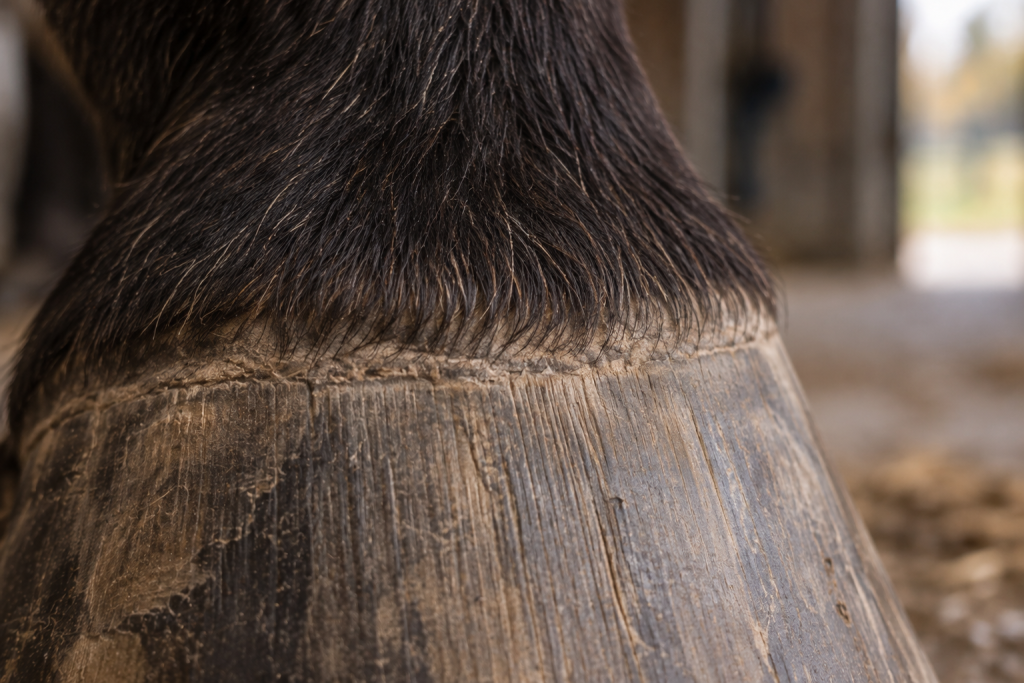

Brokkelhoeven are common in horses. Small pieces of the hoof wall break off and sometimes cracks develop. Although this can sometimes be the result of an excessively long hoof wall, it can also be related to the quality and strength of the hoof wall.
Because hooves continuously grow and renew, the body constantly needs sufficient building blocks for the formation of new hoof tissue. When a horse does not receive enough building blocks, this can affect the quality of the newly formed hoof tissue. Therefore, a balanced ration that provides all the necessary nutrients is essential for hoof health.
Before the body can use nutrients for the formation of new hoof cells, sufficient energy must be available. The cells responsible for the growth and renewal of hoof tissue depend on an adequate energy supply to do their work. A balanced ration therefore forms the basis for normal hoof growth.
The hoof consists of different structures, in which proteins play an important role in its formation and strength. Both the hoof wall and the underlying tissues contain protein structures that contribute to the strength of the hoof.
For the formation of these proteins, the body uses amino acids. These building blocks are not only needed for the production of keratin in the hoof wall, but also for the formation of collagen in the supporting tissues of the hoof. A good supply of amino acids therefore contributes to the development of healthy hoof tissue.
Zinc is involved in various processes that are important for the growth and maintenance of hoof tissue.
The cells from which the hoof wall is formed need zinc for their normal development and renewal. In addition, zinc supports enzymatic processes involved in the formation of important structural components of the hoof.
Because the zinc content of roughage and grains is not always sufficient to fully meet the horse’s requirements, zinc is often mentioned as an important point of attention in hoof nutrition.
Copper plays a role in the formation and maintenance of different types of connective tissue in the body.
This mineral is involved in structures such as tendons, ligaments, cartilage and the skeleton. In addition, copper is associated with properties of the outer layers of the hoof wall.
For this reason, copper is often regarded as an important part of a diet aimed at supporting a healthy hoof.
Where zinc and copper are often mentioned in relation to the hoof wall, manganese mainly plays a role in the deeper structures of the foot.
Manganese is involved in the formation of chondroitin sulphate, a component of cartilage. As a result, it supports processes that are important for the maintenance and repair of cartilage tissue.
Biotin is probably one of the best-known nutrients when it comes to hoof care and hoof health.
This vitamin plays a role during the development of new hoof cells. Biotin is involved in processes that contribute to the cohesion between individual hoof cells. A good connection between these cells is important for the formation of hoof tissue.
Healthy hooves start from the inside! The quality of the hoof is not determined by one single nutrient. Hoof formation is a complex process in which energy, amino acids, vitamins and minerals work together.
Proteins provide the building blocks for new hoof structures. Minerals such as zinc, copper and manganese support processes involved in growth, maintenance and structure. Biotin plays a role during the development and cohesion of hoof cells.
By providing a balanced ration with the right nutrients and the correct proportions, the body receives the building blocks needed for the continuous growth and renewal of healthy hoof tissue!
What are the most common causes of a dull coat? The condition of the coat can be influenced by nutrition, care, management and the health of the horse.
Which nutrients are important for a healthy, shiny coat? Nutrients that are important for a healthy, shiny coat include high-quality proteins, amino acids, fatty acids, vitamins and minerals. Amino acids such as lysine and methionine, for example, play an important role in the production of keratin, an important component of hair.
Is your horse getting enough omega-3 fatty acids? Omega-3 fatty acids can support coat health and hair growth. Horses can obtain considerable amounts of omega-3 fatty acids through their diet in the form of alpha-linolenic acid (ALA). However, the conversion of ALA into other fatty acids is not very efficient. In addition, the omega-6 content in concentrates is often higher compared with omega-3 fatty acids. It may therefore be advisable to supplement omega-3 fatty acids in the ration. Omega-3 fatty acids are, for example, present in high amounts in linseed products, such as linseed oil.
Does grooming influence the appearance of the coat? Dirt, dust and loose hairs can reduce the shine of the coat. Regularly grooming your horse helps distribute the skin oils over the hairs and removes dirt and dust. In addition, brushing improves blood circulation in the skin, allowing nutrients to reach the hair follicles more effectively. This plays an important role in maintaining a healthy, shiny coat.
What are other possible causes of a dull coat? Other possible causes of a dull coat include housing and seasonal influences. In addition, breed, age and even parasites can play a role in the shine of your horse’s coat. If the shine does not return, it may therefore be advisable to determine the cause together with a veterinarian.
Receive the latest offers, exclusive content and news from Hartog Family Farms.