

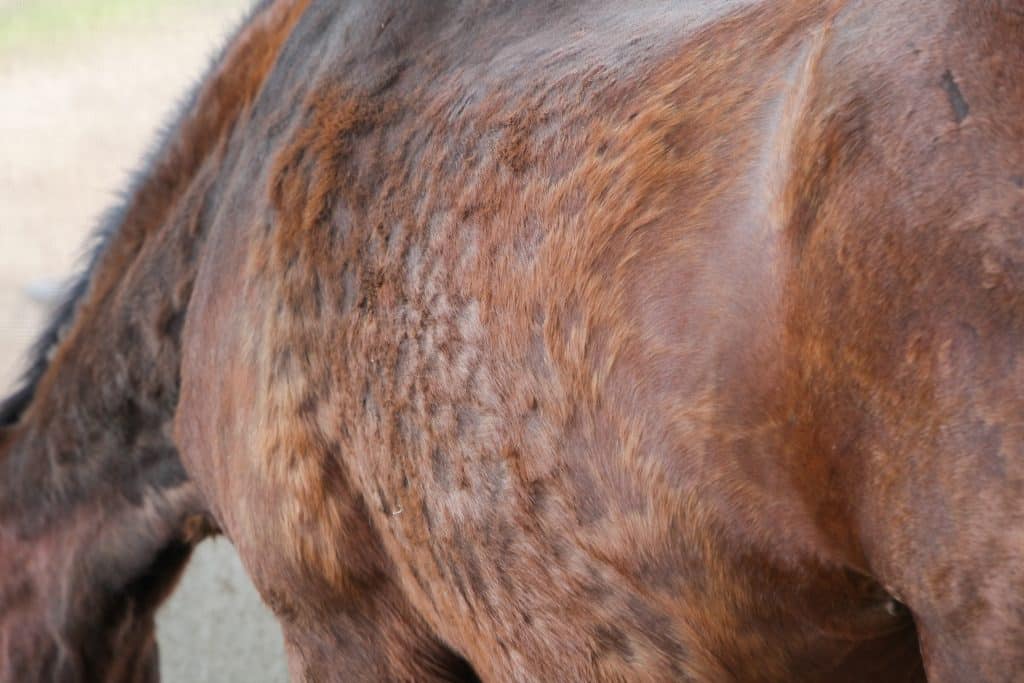

Twice a year your horse changes coat. In spring the thick winter coat disappears, and in autumn a warmer one grows back in its place.
It is a natural process, but it does not run smoothly for every horse. Some horses hold on to their coat for weeks while the rest of the yard is long finished. And sometimes the new coat is duller than you had hoped.
Nutrition, age, health and management all play a part.
During a coat change a horse forms millions of new hairs. That takes energy and building blocks. Hair consists largely of keratin, which is built from amino acids. Sufficient quality protein, essential fatty acids, vitamin A, biotin, zinc and copper support the development of healthy skin and a glossy coat from the inside.
Shedding is mainly driven by day length. As the days grow shorter or longer, your horse’s hormonal balance changes and the production of a new coat is set in motion.
In some horses that process is disrupted. The best known example is PPID, also called Cushing’s. These horses often keep a strikingly long or curly coat and struggle to shed.
In a healthy horse, the coat change usually happens by itself. That does not mean nutrition plays no part. The process starts on its own, but the body still has to build the new coat from something.
Keratin: a structural protein built from amino acids.
If the ration does not contain enough quality protein, this can affect the formation of new hairs. Coat quality may decline and the renewal of the coat may become less efficient.
What matters here is not only how much protein the ration contains, but above all its composition. Essential amino acids such as lysine and methionine are important, because your horse cannot produce them itself and has to obtain them from the ration.
A healthy coat is not only about the hairs themselves, but also about the condition of the skin underneath.
Essential fatty acids form part of the cell membranes of skin cells and contribute to a well-functioning skin barrier. This protective layer helps retain moisture and supports the skin’s resilience against external influences.
The skin also produces a natural oily layer that covers the hairs. This layer helps prevent dehydration and contributes to the natural shine of the coat.
Many horses take in plenty of omega-6 fatty acids through their ration. The intake of omega-3 can be lower, particularly when the ration consists mainly of hay and concentrates and contains little fresh grass.
Vitamin A supports the normal function of the skin. Deficiencies are not common, but they can develop when horses depend for long periods on older or lower quality hay. Lucerne is a good source of provitamin A.
Biotin is best known for its role in hoof health, but it also supports processes in the skin. A shortage can become visible in the condition of skin, coat and hooves.
One difference is worth knowing: hoof horn grows slowly and hair does not. In the hoof it takes months before a change in the ration becomes visible, whereas the coat responds sooner. You can read more in our article on the benefits of biotin for horses.
Several minerals and trace elements are involved in the quality of skin and coat. Two stand out.
Zinc plays a role in the formation of keratin, the main structural component of hair. If the supply falls short, skin and coat can be affected.
Copper supports coat pigmentation among other things, which means it plays a role in the depth and intensity of the coat colour. Copper is also involved in the formation and maintenance of connective tissue in the skin.
A good supply of zinc and copper supports the structure and appearance of the coat, and in doing so contributes to the coat change and to a healthy looking horse.
Nutrition matters for a healthy coat from the inside, but other factors come into play as well.
Age, general health, possible hormonal disorders and your horse’s overall condition all influence how smoothly the coat change goes. In older horses the teeth often play a part: what is not chewed properly is not absorbed properly either.
Nutrition can support healthy skin and a healthy coat, but it is always part of a bigger picture.
Shedding is a natural process, triggered by the changing length of the day. To produce a new coat, the body then needs the right building blocks and nutrients.
A ration with sufficient quality protein, omega-3 fatty acids, vitamins and trace elements supports skin and coat during this period. Combined with good management and attention to your horse’s health, that is the basis for a smooth coat change and a healthy, glossy coat.
Which nutrients are important for a glossy coat? Quality protein with sufficient lysine and methionine, essential fatty acids, vitamin A, biotin and the trace elements zinc and copper.
Why is hair made of protein? Hair consists largely of keratin, a structural protein built from amino acids. Lysine and methionine are essential here, because the horse cannot produce them itself.
What does zinc do for a horse’s coat? Zinc plays a role in the formation of keratin, the main structural component of hair. If the supply is insufficient, the quality of skin and coat can decline.
Why has my horse’s coat gone dull and faded? Copper supports coat pigmentation and therefore plays a role in the depth and intensity of the colour.
My horse is not shedding. What could be going on? Age, general condition and health all play a part. If your horse keeps a strikingly long or curly coat, have it checked for PPID (Cushing’s).
When should I adjust the ration for a coat change? Preferably before the coat change starts, because the new coat is built from what is available at that moment.
Receive the latest offers, exclusive content and news from Hartog Family Farms.